Curious Copepodite
Your Perfectly Planned Ocean Activity: Spring Phytoplankton Bloom Ages 9-14
Your Perfectly Planned Ocean Activity: Spring Phytoplankton Bloom Ages 9-14
Couldn't load pickup availability
You open the PDF… and suddenly, you’re not at home anymore.
You’re on a small island with Leo, an 11-year-old who has been waiting all winter for the dolphins to return.
But something strange is happening in the water.
The sea is changing color. Tiny things are moving inside a bottle. The fishermen are worried. And somehow, all of this seems to be connected to the dolphins.
This isn’t one of those random printable packs you’ve seen a hundred times.
It’s a story-led marine science unit where children investigate what is happening, follow the clues, and gradually discover how something microscopic can change an entire marine ecosystem.
And you don’t need to know anything about phytoplankton to teach it.
I’ve already done that part for you.
The story introduces the core science, and every activity builds from there. Your child can reconstruct the food chain, investigate real plankton, play with the seasonal dynamics of the ocean, interpret real oceanographic maps, grow their own miniature bloom, investigate harmful algal blooms, and eventually step into the role of the person responsible for managing a coastal bloom crisis.
They aren’t just learning facts about phytoplankton.
They’re learning to ask real questions: What happened first? What evidence do I have How are these things connected? What information am I missing?
That’s the kind of science I want children to experience.
Created by a marine scientist
This unit is designed by an oceanographer and scientific illustrator (me).
That means you don’t have to spend your evening trying to work out whether the science in a printable you found online is actually right.
I’ve taken real marine ecology and translated it into something children can investigate, discuss, build, draw, compare and understand.
The science stays real.
The experience becomes accessible.
For the child who has outgrown “cute science worksheets”
Between 9 and 14, children are capable of much more than memorizing vocabulary and filling in blanks.
They want to know why things happen.
They can look for patterns, argue with an explanation, interpret evidence, make decisions and understand that the answer to a real scientific problem isn’t always sitting neatly at the bottom of the page.
So this pack gives them something to think about.
They’ll encounter real satellite and oceanographic data, ecological relationships, harmful blooms, marine toxins, uncertainty, human consequences and environmental management.
But they’ll meet all of that through stories, games, experiments, maps, art and investigation.
And for the parent who does not want another subject to prepare from scratch
You do not need a marine science background.
You do not need to research every activity before you begin.
And you definitely do not need to complete all 77 pages.
Each activity includes guidance for you: the science behind it, what to do, what to discuss and ways to extend the experience if your child wants more.
Start with the story.
Then choose what fits your child, your week and your energy.
Do one activity.
Spend several days exploring the whole unit.
Leave half of it for another time.
There is no homeschool police coming to check.
What your child will do
- Follow Leo’s story and solve the mystery behind the returning dolphins.
- Reconstruct a marine food chain and connect seawater, phytoplankton, zooplankton, fish and dolphins.
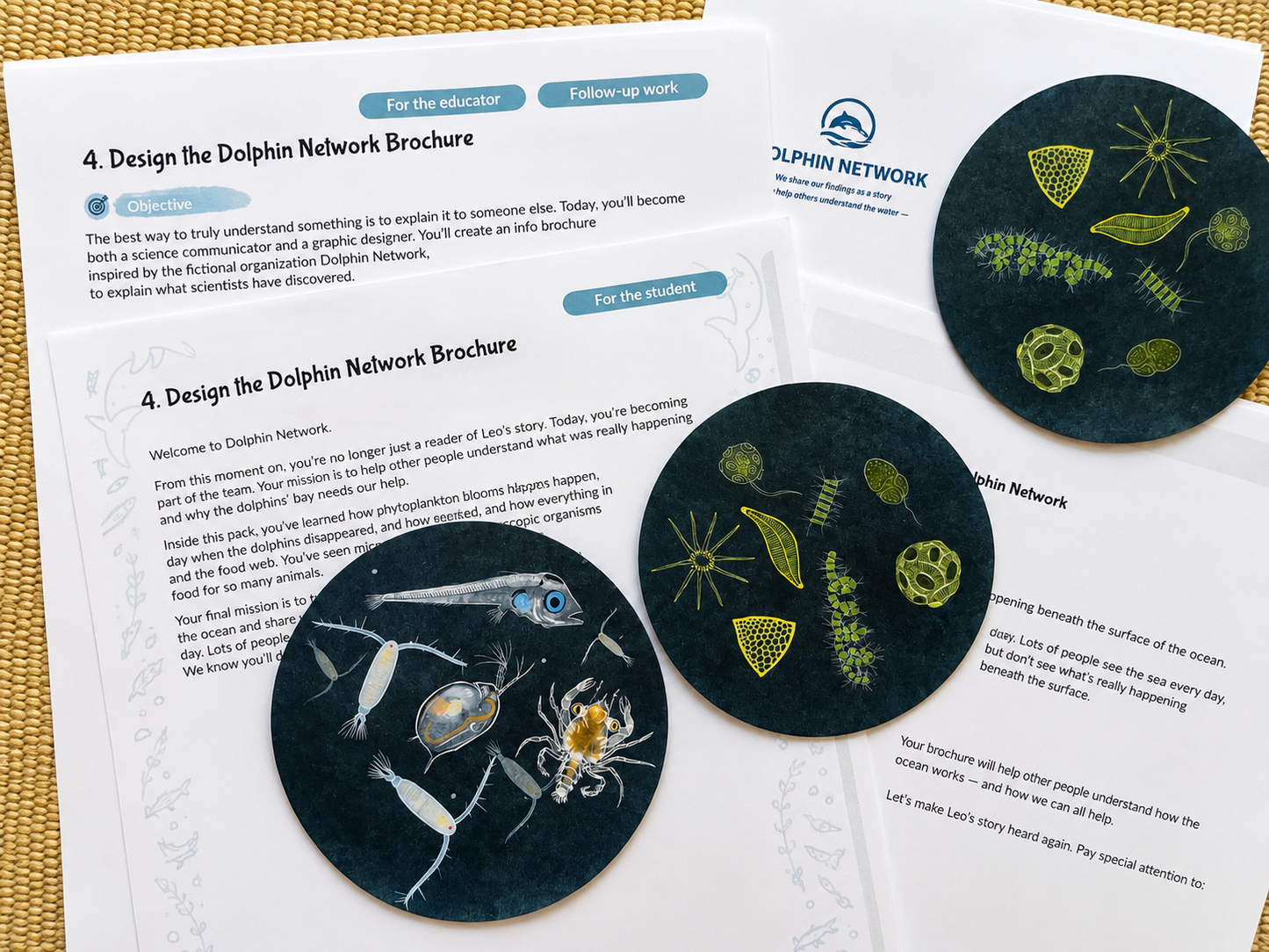
- Explore real phytoplankton and zooplankton using Montessori-inspired classification cards.
- Play a card game where seasons, food availability and unexpected environmental events change the ecosystem.
- Join the fictional Dolphin Network and design a real science communication brochure.
- Compare real oceanographic maps and identify productive regions and seasonal blooms.
- Set up a simple experiment to investigate how light and nutrients influence the ocean.
- Investigate harmful algal blooms and the movement of toxins through a food web.
- Become the manager of a coastal town facing a possible harmful bloom and decide how to protect people, wildlife and the local economy.
What you get
- 8 guided educational activities for ages 9–14.
- A story-led approach that introduces the central concepts before the activities begin.
- Hands-on science, investigation, games, art, design and real-world problem solving.
- Montessori-inspired materials and opportunities for independent exploration.
- Real oceanographic maps, scientific images and ecological case studies.
- Adult guidance with scientific background, discussion ideas and activity instructions.
- Age adaptations and extension ideas.
- Printable materials ready to use at home or in the classroom.
- Original illustrations created by a human scientific illustrator (me!).
- Simple materials for most activities, with no expensive science equipment required.
- Bilingual resource: you receive one PDF in English and one in Spanish.
- 77 pages in each language version.
- Instant digital download after purchase.
And perhaps most importantly:
You don’t have to choose between science that is accurate and learning that is interesting.
You can download both files immediately after completing your purchase.
Please double-check your cart before completing your purchase.
I don’t do refunds on PDFs (sad trombone).
Make sure it’s the unit you want.
Make sure it’s the age range you need.
And then welcome to the bloom.